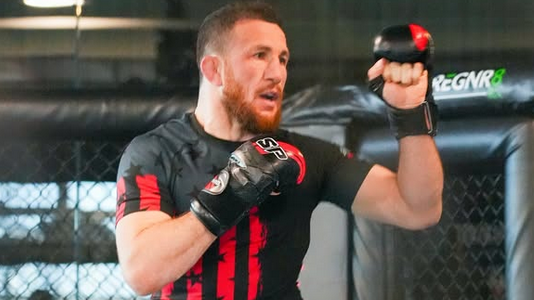
Merab Dvalishvili is not just defending his bantamweight crown this weekend against Cory Sandhagen, he is also defying modern conventions of mixed martial arts preparation. On a recent appearance on Demetrious Johnson’s podcast, the reigning UFC champion shared candid details of his training and weight-cutting routine. His revelations painted the picture of a fighter who thrives on discipline but ignores the performance science embraced by much of today’s elite.
Merab Dvalishvili is still Weight Cutting the Old Way
Most fighters in 2025 employ sports nutritionists and advanced hydration protocols to cut weight safely. Dvalishvili prefers a path that borders on brutal. He explained that beginning Tuesday night of fight week, he completely stops eating and drinking until weigh-in Friday morning.
All of Wednesday, no food, no water. And I train, I need to sweat. I don’t go to the sauna, I don’t take hot baths. I just run to sweat, Dvalishvili told Johnson. It’s hard, but when I’m running on the treadmill on Wednesday or Thursday, I want to cry, but I smile.
That approach recalls the judo roots of his youth, where fasting was the norm to make weight. Yet, despite skipping modern recovery methods, Dvalishvili has never missed the scale.
💥🤯 Merab Dvalishvili revealed he doesn't warm up and barely stretches at practice, he just jumps straight into the training.
— Home of Fight (@Home_of_Fight) September 30, 2025
He revealed some crazy details to his training regime on Demetrious Johnson podcast:
✅ He doesn’t warm up and barely stretches. He jumps straight… pic.twitter.com/rh5fo08oF3
Sleep and Recovery on His Own Terms
While many professional athletes invest heavily in recovery, LeBron James has famously spent over $1 million annually on his body, Dvalishvili insists he does little beyond sleeping when convenient. He usually heads to bed around 1 or 2 a.m. and aims for eight hours of rest, though he often falls short.
They gave me the same mouthpiece that tracks heart rate, but I don’t use it, he said. I just sleep whenever I feel like it. Sometimes it’s six hours, sometimes eight. When I feel light, I’m happy. I don’t even check my weight more than once a month.
The casual approach could be risky for most fighters, but the champion’s results suggest it works for him.
Training Without the Drills
Drilling is a cornerstone of MMA gyms around the world, but Dvalishvili says he has largely abandoned it over the last two years. Instead, he chooses to focus on live sparring and fight-scenario training.
I like positions that are close to real fighting,” he explained. I haven’t been drilling much the last two years. Because when I drill, I don’t like myself, I don’t look technical. But in sparring, I look… it’s closer to reality. If I do drills, I do them my way, tailored for myself.
This philosophy flies in the face of the structured, detail-heavy approach taken by many modern gyms. Yet, Dvalishvili’s dominance speaks for itself. He enters his clash with Sandhagen riding one of the most impressive win streaks in the bantamweight division’s history
Defying the Modern Playbook
Merab Dvalishvili’s training routine show a stark contrast between him and many of his peers. While others rely on wearable tech, strict diets, and cutting-edge recovery, the champion remains committed to a rugged, minimalist style.
Despite his unconventional methods, his consistency cannot be denied. He has never missed weight, rarely shows signs of fatigue in long fights, and has looked nearly untouchable as bantamweight champion.
As he prepares to face Cory Sandhagen in what will be his third title defense, Dvalishvili’s message is clear: results matter more than the process. His approach may not be one for coaches to teach, but it has cemented him as one of the most resilient fighters in the sport.
The Bottom Line
Merab Dvalishvili’s old-school mentality and disregard for sports science could be seen as reckless in today’s fight game. Yet, it has produced championship results in one of the UFC’s most competitive divisions. As he steps into the Octagon this weekend, the only thing that matters is whether his unconventional path can once again lead him to victory.
Follow FIGHTCORE for more updates and the latest news!