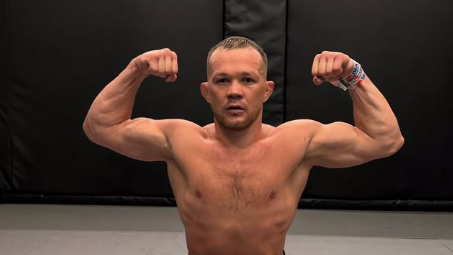
Terence Crawford’s retirement announcement did not arrive with shock theatrics or unfinished business. It came with calm certainty. At 38, undefeated at 42–0, and fresh off a career defining victory over Saul “Canelo” Alvarez, Crawford chose to leave boxing precisely when his legacy was beyond debate.
In a five minute video shared on social media, the Omaha native explained his decision in simple terms. He was not burned out, injured, or chasing one last payday. He was finished because he had done everything he set out to do.
Walking away as a great with nothing else left to prove. #CrawfordERA #1P4P #3xUndisputed #5DivisionChampion #4xLinealChampion #BWAAFighterOfTheYear #2xEspyAwardWinnerhttps://t.co/GwK3TYnIz6 pic.twitter.com/4DElhAJXIg
— Terence Crawford (@terencecrawford) December 16, 2025
Walking away after the ultimate statement
Terence Crawford’s final bout in September was not just another title defense. It was the kind of fight careers are remembered for. Moving up to super middleweight, he outclassed Alvarez over twelve rounds in Las Vegas to become the undisputed champion of the division. It was a performance built on timing, control, and adaptability, the same qualities that defined his entire career.
For Crawford, that victory answered the last remaining question surrounding his greatness. Could he dominate a larger, globally recognised superstar at the peak of boxing’s commercial spotlight? He did, convincingly.
Why Crawford chose retirement now
In his retirement message, Crawford spoke less about belts and more about peace. He described a career driven by doubt, by being overlooked, and by the constant need to prove himself against shifting narratives.
That motivation, he admitted, no longer exists.
Crawford walked away with his health intact, his record spotless, and his biggest achievement coming last. He also stepped away from potential rematches and lucrative fights, a clear signal that money was never the final driver. The challenge mattered. Once that was gone, so was the reason to continue.
I’m stepping away from competition not because I’m done fighting, Crawford said, but because I’ve won a different kind of battle.
From Omaha to boxing immortality
Crawford’s story has always been rooted far from boxing’s traditional power centers. Turning professional in 2008, he quietly built momentum before claiming his first world title in 2014, winning the WBO lightweight belt against Ricky Burns in Scotland.
From there, his rise was relentless.
He became undisputed champion at super lightweight, then again at welterweight, before making history one last time at super middleweight. Across three decades, he evolved without losing control of his identity as a fighter.
Achievements that define an era
Crawford’s résumé stands apart even in elite company. He retires as the only male boxer in the four belt era to become undisputed champion in three different weight divisions. He won world titles across five divisions and held 18 major belts in total.
More remarkably, he was never officially knocked down as a professional. All 42 wins came via unanimous decision or stoppage, with no judge ever scoring a fight in favor of his opponent.
His adaptability made him special. Crawford could switch stances mid round, break opponents down patiently, or finish with sudden violence. Few fighters in modern boxing have shown that level of technical completeness.
Respect, criticism, and the legacy debate
As with many great fighters, Crawford’s retirement sparked debate as much as praise. Some questioned his résumé. Others revisited hypothetical matchups with past legends. Oscar De La Hoya openly dismissed his achievements, while Manny Pacquiao offered respect but suggested he would have beaten Crawford in his prime.
Crawford never built his career around universal approval. He leaned into doubt and used it as fuel. The fact that his retirement has reignited arguments about his place among the greats only reinforces how rare his accomplishments were.
A career defined by control
What separates Crawford from many champions is not just what he won, but how he exited. He avoided the erosion that defines so many great careers. No late losses. No forced comebacks. No farewell tours.
Instead, he left as the reigning WBA, IBF, and WBO super middleweight champion, having already accepted the loss of the WBC belt as a minor administrative footnote rather than a defining issue.
This was a fighter in full control of his narrative.
What comes next for Terence Crawford
Terence Crawford has hinted at mentoring, family life, and giving back to his community in Omaha. He has trained his sons in wrestling and spoken openly about the importance of guiding the next generation. Whether he remains involved in boxing or chooses a quieter path, his place in the sport is secure.
Follow FIGHTCORE for more updates.
Also read, Ilia Topuria Opens Up on Future: Boxing Career Coming After Final UFC Title Push